

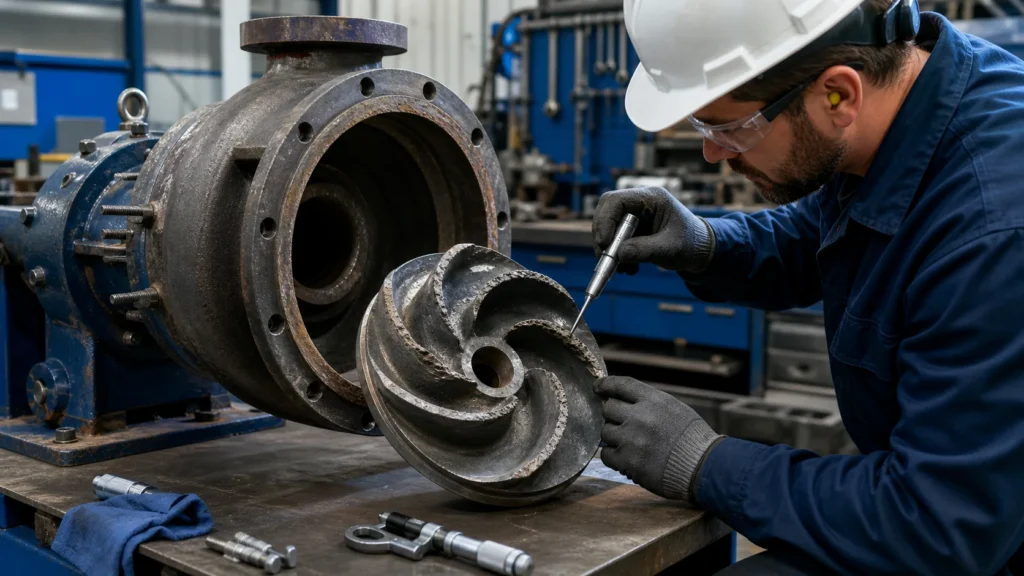
Industrial pump cavitation can reduce flow, damage impellers, destroy bearings, and force an unplanned shutdown. It occurs when pressure inside the pump drops low enough for vapor bubbles to form. When those bubbles collapse against the impeller or casing, they create repeated impacts that remove metal and disrupt hydraulic performance.
What causes pump cavitation?
Common causes include insufficient net positive suction head, a clogged suction strainer, undersized suction piping, excessive pump speed, high liquid temperature, restricted inlet valves, air leaks, or operating too far from the pump best efficiency point. A worn impeller or incorrect clearance can make the problem worse.
Warning signs of cavitation
- Crackling or gravel-like noise inside the pump
- Increasing vibration at the pump and bearings
- Unstable discharge pressure or reduced flow
- Higher bearing temperatures and repeated seal failures
- Pitting or erosion on impeller vanes and casing surfaces
- Unexpected increases in energy consumption
Why cavitation damage should not be ignored
Even mild cavitation can change impeller geometry and reduce efficiency. As vibration increases, damage may spread to the shaft, mechanical seals, bearings, wear rings, and casing fits. Repairing the root cause early is usually less disruptive than replacing multiple rotating components after failure.
How an industrial pump is evaluated
A professional inspection begins with operating data, suction and discharge conditions, and vibration history. After teardown, technicians inspect casing thickness, impeller profiles, shaft runout, bearing fits, wear-ring clearances, and seal surfaces. Non-destructive testing can reveal cracks that are not visible during routine inspection.
Pump repair options
Depending on the damage, an impeller may be rebuilt with high-alloy welding, restored with protective coatings, dynamically balanced, or replaced. Shafts can be straightened or manufactured in-house, casing bores can be restored, and new wear rings, bearings, seals, packing, and gaskets can return the pump to proper clearances. Hydrostatic and performance testing should verify pressure, flow, and leak-free operation before return to service.
Preventing future cavitation
Confirm adequate suction pressure, keep strainers and lines clear, eliminate air leaks, verify valve position, and operate near the manufacturer recommended range. Trend vibration, temperature, flow, and pressure so small changes are identified before damage becomes severe.
Industrial pump repair across the Pacific Northwest
Northwest Gear Repair provides complete industrial pump repair and refurbishment for centrifugal, vacuum, and vertical turbine pumps. Services include precision diagnostics, machining, dynamic balancing, sealing, and performance testing, backed by a 24-month warranty. Contact our pump repair team or call (360) 706-1865.