

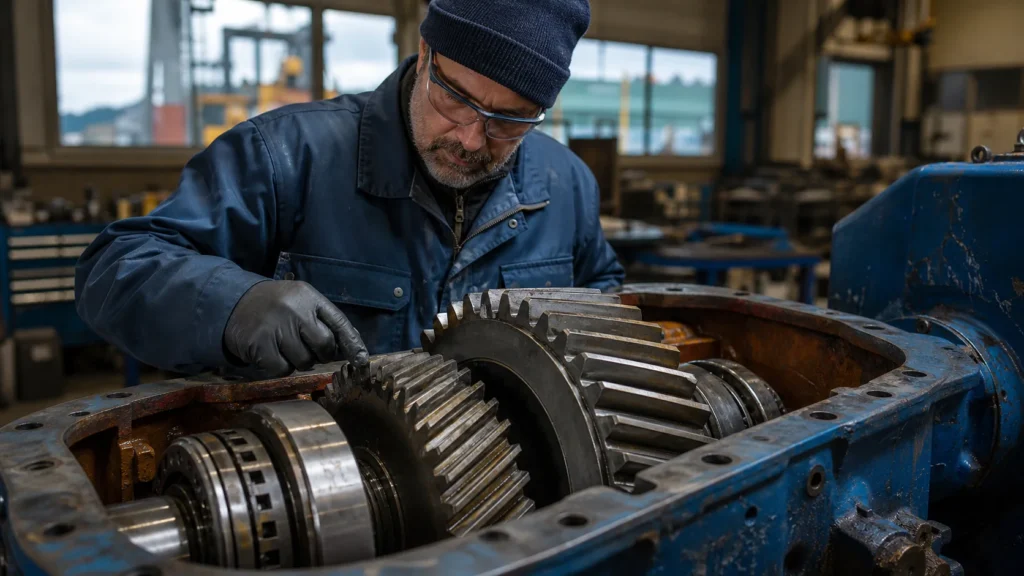
An industrial gearbox rarely fails without warning. The challenge is recognizing small changes before damaged bearings, gears, seals, or shafts stop production. For plants across Washington, Oregon, Idaho, Montana, Wyoming, Nevada, and Utah, early diagnosis can turn an emergency replacement into a planned industrial gearbox repair.
1. Unusual noise from the gearbox
Grinding, clicking, whining, or rumbling often indicates worn gear teeth, incorrect backlash, bearing damage, or poor lubrication. A new sound should be documented with the operating load and speed, then investigated before continuing production.
2. Increasing vibration
Misalignment, shaft runout, imbalance, loose mounting hardware, and damaged bearings can all increase vibration. Trend readings are more useful than a single measurement. A steady rise at the same operating condition is a strong reason to schedule inspection.
3. Gearbox overheating
High temperature can result from low or contaminated oil, excessive load, incorrect viscosity, poor ventilation, or internal friction. Check the oil level and cooling system, but do not assume topping up lubricant solves the root cause.
4. Oil leaks or contaminated lubricant
Failed seals can allow lubricant to escape and moisture or debris to enter. Milky oil suggests water contamination; metallic particles may indicate active wear. Oil analysis helps identify whether the source is gears, bearings, or another internal component.
5. Reduced torque or inconsistent output
A gearbox that struggles under normal load may have damaged teeth, slipping couplings, worn bearings, or shaft alignment problems. Continuing to run it can spread damage throughout the drive train.
6. Excessive backlash or shaft movement
Unexpected play at the input or output shaft can point to bearing wear, loose fits, or deteriorated gear geometry. Precision measurements are necessary to determine whether components can be restored or must be fabricated.
7. Repeated seal or bearing failures
Recurring component failures usually indicate a deeper problem such as misalignment, housing distortion, improper fits, contamination, or vibration. Replacing the same part again without correcting the cause only delays the next shutdown.
What a professional gearbox inspection includes
A complete evaluation should include teardown, chemical cleaning, non-destructive testing, dimensional inspection, bearing and seal analysis, backlash verification, and a documented repair recommendation. When obsolete parts are involved, in-house reverse engineering and gear or shaft fabrication can reduce OEM lead times.
When to stop the gearbox
Shut equipment down according to your facility safety procedures if you detect rapid temperature rise, severe vibration, visible oil loss, broken-tooth noise, smoke, or sudden performance loss. Protecting the housing and shafts from secondary damage can significantly reduce repair scope.
Gearbox repair in the Pacific Northwest
Northwest Gear Repair provides certified industrial gearbox repair, precision component fabrication, testing, and 24/7 emergency rush repair. Repairs are backed by a 24-month warranty. For a technical evaluation, request a gearbox repair quote or call (360) 706-1865.